
Thursday, 09 April 2015 10:22
Download a PDF of this case study here.
Jones Dorm Abatement & Demolition
Asbestos was once a friendly mineral with hugely useful properties for numerous applications. Its tensile strength and resistance to damage from heat, chemicals and fire, plus its soundproofing ability and low cost, made it a best friend to builders. Until we determined how much lung damage it caused, it was one of the most widely used and affordable construction materials in the world. Though it fell out of mainstream use and was banned in many places across the developed world, many aging buildings in the US still play host to asbestos. Since it’s only dangerous when disturbed and released into the air, infrastructure upgrades are forcing owners of aging buildings to carefully remove these dangerous minerals before proceeding.
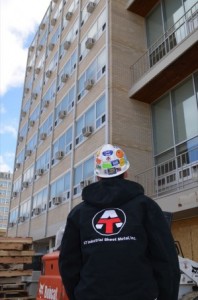
Jones dorm, pictured above, at the University of Missouri in Columbia, is one such asbestos-laden facility that was still in use until this year when AT Abatement and Demolition were brought on to deconstruct the 1960s era building as part of the Dobb’s group replacement phase 1. While the asbestos in the building didn’t pose any particular risk to residents (though had the potential to make repairs much more dangerous), the out-of-date building was no longer meeting the needs of the students housed there, and university curators decided it was time to replace the facility. The building will be replaced by a modern residence hall that doesn’t use these dangerous materials and is part of the final phase of the University’s overall upgrade to modern student housing. But before a new building can be built, the old one must be removed.
AT Abatement
The first step for AT Abatement to prepare the building for demolition is to go through every room in the hall and donate leftover items and removable fixtures to charity. Many of the desks, chairs, bed frames and air conditioning fixtures are still in serviceable, and even good, condition – and AT believes that an important part of its mission is giving back to the community. These items will no longer be used by the college’s students, but instead of sending them to be destroyed, they will be given a new purpose helping someone in need. All in all, removal of the leftover fixtures in the building took about a week to a week and a half. Only once all of the fixtures were removed, to protect them from dangerous asbestos dust, could our team and the university’s environmental department enter the building and begin the asbestos removal process.
The Abatement Process
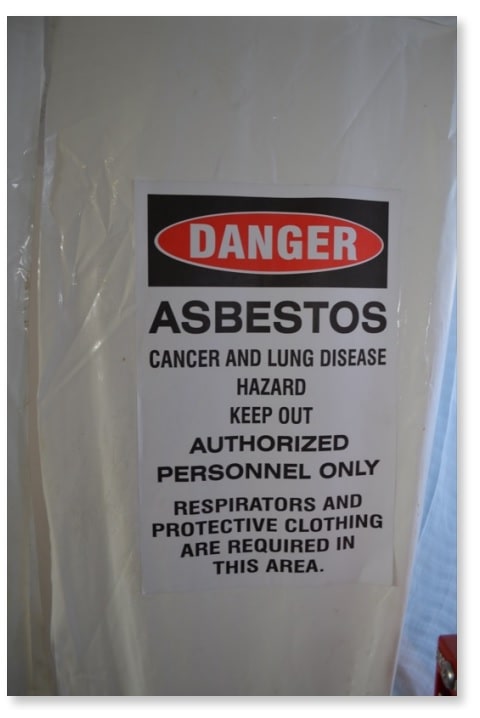
This process starts with sealing the building, in this particular case, two levels at a time. Using a plastic seal containment, all windows, exits, and ventilation shafts are covered to stop any asbestos from escaping. Jones hall featured a common 60s era application for asbestos, using it in an adhesive to secure the tiling to the floor – reducing noise penetration and slowing any unexpected fires. It also unknowingly put students mere feet away from potentially cancer-causing materials. AT Abatement’s team of 13 carefully pulls these tiles up, wearing full personal protective equipment, and prepares them for disposal using a special mastic adhesive removal chemical that destroys asbestos. Even so, all debris is destroyed to prevent accidental exposure.
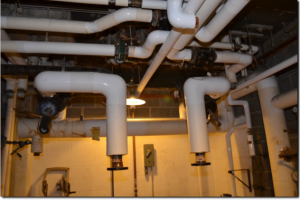
Of course, in buildings as old as Jones Hall, asbestos was used for a lot more than just coating floors and tiling, it was also used as insulation for piping (shown above), meaning that it can potentially be found anywhere and everywhere inside the walls. Making sure asbestos doesn’t escape and create a serious environmental hazard require a lot of internal demolition. AT checks every wall for signs of asbestos and insulated pipe for signs of asbestos. Having a specialized abatement team makes this kind of demolition work possible, we prevent environmental disasters by doing it safely.
Once we’ve located all of the asbestos, we carefully remove it and clean the area. To make sure that none of the contaminants escape, each area of the building is thoroughly cleaned after removal of the dangerous materials. This includes cleaning the plastic that wraps the floors where work is being done. The cleaning products used to destroy the asbestos, and are disposed of afterward to minimize danger to workers and the public. The process must be repeated for each set of floors in the building and the ground floor. This is a total of 5 contamination zones that must be contained, abated and cleaned. When the abatement is finished, AT gets a final inspection performed by a university environmental protection official. Only once all of the abatement is finished and everything has been cleaned, removed for proper disposal, and the inspector has signed off on it so we start the actual demolition process.
Jones Hall is located right near modernized student housing and directly across the street from a set of fraternity houses. While it would certainly be more convenient to lace the hall with explosives and let it come crashing down on itself, it would be much less friendly to the habitability of the nearby residences. The only option for the demolition is a deconstruction, from the top down.
The Demolition Process
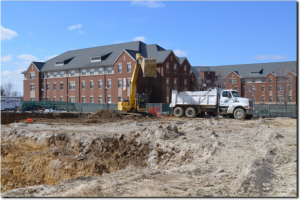
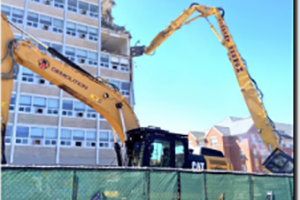
Using the expertise of structural engineers, our demolition teams carefully plan the best way to deconstruct the building, one that is both efficient and will not cause unforeseen damage or structural collapse. It is, naturally, a top-down process for this very reason. To complete the demolition, we have to use a high reach excavator that takes two to three days to set up. With it our teams can reach up to 190 feet above the ground where we will use the giant, shearing demolition processor on the end of the long arm to deconstruct the building piece by piece and floor by floor (pictured at left).
While the deconstruction process is underway, we also do everything possible to keep down the impact on the local community. Especially with a VA hospital, university hospital and residence halls in close proximity, it’s extremely important that the dust is kept to minimal levels. Water cannons are one important feature of every demolition that helps to keep the dust to a minimum. The high reach excavator is also equipped with a water nozzle that knocks the dust down before it reaches far into the air. During the entire demolition process, access to the site is strictly controlled to protect public safety. Usually, only a small demo team is allowed in and is carefully briefed on safety to protect all workers involved with the project. The team only works during certain university-approved daytime hours to avoid being a nuisance to the nearby residences.
A Large Project with Focus on Safety
As our largest demolition project to date, the deconstruction of Jones Residence Hall will be a milestone for AT Industries. At 9 stories, this will be one of the tallest buildings our team has ever demolished. The entire demolition project is expected to take around 3 months, and new construction is already underway on the back side of the building – meaning that we can actually only tear down the old building from one side.
Through every phase of demolition, AT’s primary concern is always safety. Employees at AT are trained to constantly protect themselves, their colleagues and the public. No mandate is more important for our team, and that’s why we take such care in dealing with highly dangerous substances like asbestos. The Jones dorm demolition and deconstruction project is a perfect example of how AT Abatement and Demolition work in unison to safely remove hazardous materials and entire structures leftover from a bygone era.
Let’s Get Social
See more information about this project by following AT Industries, our parent company, on Facebook and on Twitter @ATIndustiesinc. Use #dobbsconstruction to see the progress of the Jones dorm demolition project on Twitter.
Contact Us
To contact us, please fill out the form below and an associate will get back to you as soon as possible. Thank You.
Get in Touch with Us
Do you wish to talk with one of the associates from AT Industries, Inc.?
We are happy to help.